
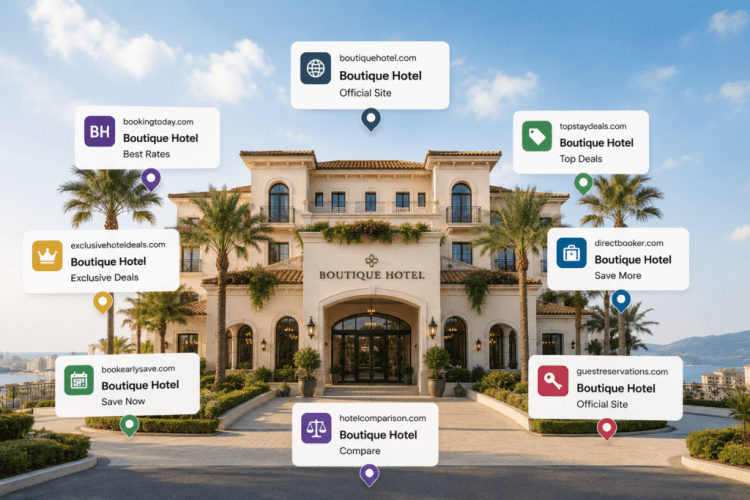
Every hotel competes for the same outcome: earning a guest’s decision.
Marketing campaigns, search engine optimization, loyalty programs, guest reviews, social media, public relations, and memorable guest experiences all serve the same purpose: to convince a traveler that your hotel is the right place to stay. Every investment in a brand ultimately serves the one purpose of earning a traveler’s decision.
When a traveler finally searches for your hotel by name, most hoteliers assume the hardest part is over. The guest has made a decision. They’ve discovered your property, compared their options, and chosen where they want to stay.
But that’s not always where the booking journey ends.
Increasingly, another company inserts itself between that decision and the reservation. The guest still books the same hotel. They still arrive on the same day and stay in the same room. The only difference is that the booking takes a different path, one that often results in an unnecessary commission and a weaker relationship between the hotel and its guest.
That moment deserves a name.
Hotel Brand Hijacking
Hotel Brand Hijacking is the practice of intercepting guests who have already chosen a hotel by inserting an unnecessary third-party booking channel between the guest’s decision and the hotel’s direct booking experience.
One of the primary ways Hotel Brand Hijacking occurs is through Predatory OTAs, booking websites that compete for guests who have already chosen a hotel.
By the time a traveler searches for a specific hotel, the hotel has already done the difficult work. Its reputation, marketing, location, guest experience, and brand have already earned the guest’s trust. The traveler isn’t deciding where to stay, they’re deciding how to complete a booking.
Traditional hotel marketing is built around creating demand. Hotel brand hijacking begins after demand has already been created.
The Hotel Already Won the Guest
Most conversations about direct bookings revolve around attracting more travelers. Hotels discuss improving search rankings, increasing website traffic, investing in advertising, optimizing conversion rates, and strengthening their online presence. These are all worthwhile investments because they help generate demand.
Brand hijacking starts at a different point in the journey.
The traveler has already made a choice. They’re no longer comparing hotels or deciding between destinations. They’re looking for one specific property. (How does that actually happen? See how guests end up booking through Predatory OTAs.)
That moment is one of the most valuable commercial assets a hotel can earn. That moment is Guest Intent.
Guest Intent is the point at which a traveler has intentionally chosen a specific hotel. It’s the moment every marketing campaign, every five-star review, every recommendation, and every dollar invested in building a brand has been working toward.
From that point forward, the objective changes. The challenge is no longer convincing the traveler to choose your hotel. The challenge is protecting the decision they’ve already made.
That’s why Hotel Brand Hijacking deserves to be recognized as a distinct commercial challenge. It isn’t simply another marketing problem or another distribution challenge. It’s about preserving the demand a hotel has already earned.

Why It’s Difficult to See
Hotel Brand Hijacking rarely announces itself. A hotel’s marketing team may search for its own property and see the official website exactly where it expects it to be. Meanwhile, a traveler searching from another city, another country, or another device may see a completely different set of advertisements and booking options. Search results vary based on location, browsing history, paid advertising, device, and countless other signals.
By the time a reservation reaches the hotel, it simply appears as another third-party booking. There’s nothing about the reservation itself that reveals whether the guest discovered the hotel through a distribution partner or whether they had already intended to book directly.
For many hotels, that distinction has remained almost impossible to measure. As a result, unnecessary commissions have often been accepted as a normal cost of online distribution rather than questioned as a separate commercial issue.
Not Every OTA Is the Same
It’s important to distinguish hotel brand hijacking from the role that many online travel agencies play in the hospitality industry.
Distribution partners introduce hotels to new travelers every day. They help properties reach markets they might not otherwise access, fill rooms during periods of lower demand, and generate bookings that may never have happened through direct channels alone. That value is real.
Hotel brand hijacking describes something different.
It refers to situations where a traveler has already decided to stay at a specific hotel, yet another booking channel positions itself between that decision and the hotel’s direct booking path. The issue isn’t that a commission exists. The issue is whether that commission was necessary to create the booking in the first place.
That distinction will become increasingly important as the industry continues to rethink the relationship between direct bookings, distribution, and guest acquisition.
A New Way to Think About Direct Bookings
The conversation around direct bookings has traditionally focused on creating more demand. Hotel Brand Hijacking doesn’t replace that conversation—it reframes it.
Once a traveler has intentionally chosen a hotel, the challenge is no longer generating demand. It’s protecting the guest intent that already exists. That shift changes the conversation from simply acquiring more bookings to understanding how much of the demand a hotel has already earned actually reaches its own booking channel.
Perhaps the most important contribution of Hotel Brand Hijacking is that it gives the industry a common language for a challenge it has long experienced but rarely discussed. Once a problem can be clearly described, it can be measured, understood, and ultimately addressed.
Brand hijacking doesn’t create demand. It captures demand someone else already created. Hotels have earned that demand. It’s time they started protecting it.
Is Your Hotel Being Targeted by Predatory OTAs?
Understanding the problem is the first step. The next is finding out whether it’s affecting your hotel. See how third-party booking sites may be competing for your direct bookings and what guests searching for your hotel are actually seeing. Get a free assessment to see whether your hotel is affected.


